Powered By Blogger
Showing posts with label olives. Show all posts

Sunday, May 1, 2011

TUTANKHAMUN'S OLIVE LEAVES 1: THE FUNERARY BOUQUETS


Olives are not native to Egypt, and it may come as a surprise that olive leaves were found in bouquets and wreaths in the tomb of the 'boy Pharaoh', Tutankhamun. In fact, olives have been cultivated in Egypt since around 1500 B.C. By about 1327 B. C., the date of Tutankhamun's burial, they were being cultivated quite widely, in private gardens as well as in the gardens of temples and mortuaries, where they provided oil for religious ritual and burial ceremonies. 

In November 1922 Howard Carter began his famous excavation of Tutankhamun's tomb. The excitement the excavators felt can be seen in the words of Carter himself. When he reached the north wall of the Antechamber, which he had found to be filled with tomb furniture, and came to a sealed doorway, "...visions of chamber after chamber, each crowded with objects like the ones we had seen, passed through our minds and left us gasping for breath".

The following photographs were taken by Harry Burton, the official photographer for the expedition, and published here with the permission of the Griffith Institute, University of Oxford.
Burton Photo. No. P0016
p0016

Photo copyright: Griffith Institute, University of Oxford

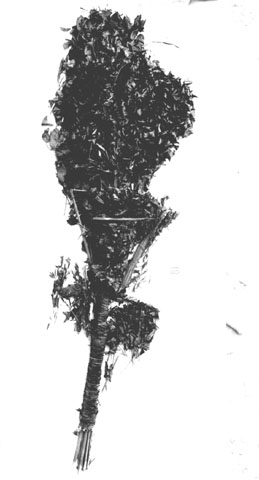
The sealed doorway led to the Burial Chamber, and in front of the doorway stood two life-sized guardian statues of the king, a magnificent painted chest, and funerary bouquets (one, marked 17 can be seen in the above image) which were composed of leaves of olive and persea (a member of the laurel family) tied to reeds. The bouquet shown here was found propped against the wall next to one of the guardian statues.

p0069
Photo copyright: Griffith Institute, University of Oxford

This fascinating second image clearly shows how reeds formed long handles for the bouquet, and the framework that held the olive and persea stems in place. We can imagine these tall bouquets being carried in the funeral procession, brought into the tomb and left there when the door to the Burial Chamber was sealed.

The original description of the bouquet on a card held by the Griffith Institute reads in part:

Position: Standing erect, against wall to right of doorway. 19 up from bottom, unbound brach (sic) ends, about 10 of them. Rest of handle above this bound round tightly with leaves applied singly. They were held in place by a binding of reed strip, now almost entirely disappeared. Above a triangular frame of reed stalk. Above apparently branches were loose. About 60 wide at widest point above. Width of triangular frame 34. Diam. of handle about 6......Sprayed with a solution of celluloid in acetone.

I imagine that these measurements are metric; with the unbound branch ends measuring 19 cm. from the bottom, it must have been a large and imposing bouquet. I don't know how well the celluloid in acetone would have preserved the  bouquets, or whether indeed the bouquets still exist. But it is wonderful to see these photographs from the original excavations, and to read the archaeologist's description, and I am grateful to the Griffith Institute for granting me permission to publish them here.


Monday, March 21, 2011

LATE SUMMER: ROSES, FIGS, TOMATOES, GREEN OLIVES AND LONG MORNING SHADOWS


the last roses

four figs on a yellow tray


tomatoes in a Chinese bowl


green olives


and long early morning shadows on the oval

Sunday, March 13, 2011

AN OLIVE HARVEST IN PROVENCE: PICKING THE OLIVES BY HAND


Carol Drinkwater , the actress who is best-known for her role as James Herriot's wife in the much-loved BBC series All Creatures Great and Small, has written a delightful series of memoirs of her life on an olive farm in Provence.  In the first of these books, titled The Olive Farm, she presents an interesting historical background to the olive, discovers that olive trees, seemingly so strong and ageless, are prone to disease, and describes the excitement of her first olive harvest and the processing of the olives into "a glorious primrose-gold oil". 
"At long last", she writes, "the moment has arrived. We are about to begin our very first harvest: la cuillette des olives". The harvesters, five men and one woman, begin work, slowly and carefully picking the olives by hand. Carol and her husband Michel, banished as amateurs to a far corner of the olive grove by their friend and mentor Rene, soon discover that this can be back-breaking work: Rene will not allow them to use rakes, every olive has to be picked singly. There is quite an element of danger, too, from picking olives while standing on ladders which often seem to be on the verge of toppling, or from climbing the trees and sitting precariously among the high branches. But she writes that all this was soon forgotten as they experienced the thrill of taking their olives to a local mill and having the first taste of their own extra-virgin olive oil.

It's a pleasure to read this book; the reader not only makes the acquaintance of a charming couple and their life in Provence, but also learns something of the history of the olive, the art of olive growing, and, ultimately, the production of extra-virgin olive oil.

You can read about the other books in the series here.
With thanks to Carol for permission to use the cover image of her book.

Sunday, February 13, 2011

HARVESTING THE OLIVES

Attic black-figure amphora attributed to the Antimenes Painter
520BC.  h. 16" (40cm.)

© Trustees of the British Museum

Today the ways in which olives are harvested range all the way from careful, highly labour-intensive hand-picking to the use of huge mechanical harvesters.

This scene from an Attic amphora shows how the Athenians harvested their olives in the sixth century BC. The painter has depicted four harvesters: two youths and two bearded older men. One youth sits high in the central tree, beating the branches with a stick; another young boy kneels on the ground as he collects the fallen olives and puts them in a basket. The two older men, holding long sticks for knocking the olives from the tree, seem to keep a close watch on  the two younger men; olives that are knocked like this can be damaged, and in particular the man on the right may be watching how carefully the boy sorts and selects the harvest.

These large and beautifully decorated  amphoras, containing the finest oil, were often presented as prizes at the Panathenaic Games. From the olive harvest scene here, it seems likely that this vessel would have served such a purpose.
 
You can read more about this amphora here, on the website of the British Museum.